In the West, no holiday is as beloved as Christmas. As soon as Thanksgiving in the United States is over, malls, newspapers, radio and TV are inundated with Christmas decorations. Red and green, Christmas lights, Santa surrounded with his elves. The mad holiday rush begins as the clock ticks down to the "holy night".
In today's age of cultural equivalence, holidays are often shorn of their meanings. However, I feel that it is important to understand the significance of the symbols associated with the holiday. To many Christians, Christmas represents the birth of their saviour and is the most important day on the calendar for them. Church attendance is highest on Christmas (and Easter). To those seeking a way to get closer to G-d, it is necessary to learn about the pagan roots of Christmas.
Christmas is celebrated on the 25th of December, not due to any particular historical event, but rather because it was the day when the ancient pagans worshipped the rebirth of the sun. On the darkest day of the year, the winter solstice, the Romans would commemorate the advent of their saviour demigod, Mithras. Born to a virgin in a cave, Mithras brought eternal life to his followers. As an inscription on a Mithraic temple in Rome said: "Thou hast saved the many through the shedding of the eternal blood". The Catholic Church, in the 4th century, wanted to eclipse the pagan festivities of Mithras by establishing the day as the birth of their own saviour man-god. In order to introduce Christianity to the pagan world, Church leaders felt it necessary to celebrate Christmas on the winter solstice. The day of the sun's rebirth easily and smoothly became the day of the son's birth. (Christmas' pagan roots were well known. The early colonists opposed the celebration of Christmas in America. It was even banned by colonial law in Massachusetts.) To make pagans feel more comfortable in their new faith, many pagan elements were incorporated into early Christianity.
The Christmas tree originated in ancient Germanic history. Germanic tribes lit trees (Tannenbaum) and celebrated the feast of light (Lichtfest) around the shortest day of the year, December 21. During the Roman celebration of Saturnalia, the people decorated their homes with evergreen clippings and hung metals and decorations from trees in honour of their god, Bacchus.
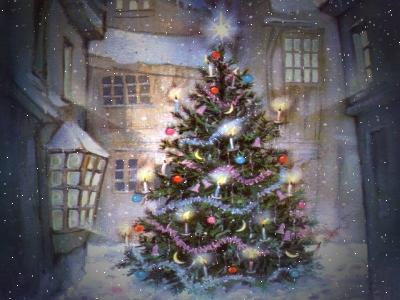
Christians, G-d specifically commands against this pagan practice:
Jeremiah 10:2
Thus saith the LORD, Learn not the way of the heathen, and be not dismayed at the signs of heaven; for the heathen are dismayed at them. 3 For the customs of the people [are] vain: for [one] cutteth a tree out of the forest, the work of the hands of the workman, with the axe. 4 They deck it with silver and with gold; they fasten it with nails and with hammers, that it move not.
Mistletoe and holy were used by the Druids to announce the coming of winter. In Scandinavian countries, mistletoe represented peace and harmony. It was associated with the goddess of love, Frigga, which is the origin of kissing beneath the mistletoe. The early church even banned the use of mistletoe because of its pagan connotations.
As a Christian site says:
"December 25th was celebrated by the Pagan sun-worshippers of Mithraism as the "birthday of the invincible sun," because on that day the sun began its return to the northern skies "the winter solstice." And so, the sun and the Son, have become a deliberate Pagan mix. Tammuz, the Babylonian Pagan sun deity, was also the first counterfeit savior… December 25th was also the date of the Pagan Brumalia (winter) festival in Rome. It was preceded by the Saturnalia festival Dec. 17-24 - in honor of the Roman god Saturn, as a period of unrestrained merriment in celebration of the winter solstice. The Saturnalia and Brumalia festivals were so popular among the heathen and so deeply entrenched in their customs, that rather than attempt to reform the Pagan populous the Roman Church, the Emperor Constantine, chose instead to absorb their festivities into the Constantine Roman Catholic Church."
There are those Evangelical and Messianic Christians who seek to rehabilitate Christmas of its pagan origins and instead celebrate the birth of Jesus on Sukkot. What they do not understand is that besides the blatant pagan symbols of the Christmas tree and elves, the very concept of a man becoming god and dying for the sins of humanity is contrary to the Torah. Such a belief is pagan to the core and the ancient world was full of similar saviour gods such as Mithras, Osiris, Dionysus and Attis. These beliefs are contrary to G-d's Torah and are idolatrous. G-d repeatedly says that He is not a man (Numbers 23:19, Hosea 11:9, I Samuel 15:29), that human sacrifice is abominable before Him and that no one can die for another's sins.
To all of my gentile readers, instead of placing your trust in meaninglessness and vanity, return to the Almighty Source. Pagan idols and manmade saviours are empty and have no power. Rid yourselves of idolatrous rites and beliefs and commit yourselves to the 7 Noahide Laws. Why worship the "son of man", emptiness and futility, when you can worship G-d Himself? Should you not observe the 7 Laws of the Sons of Noah, incumbent upon all Gentiles, whom G-d has created and loves, and wishes to get closer to?

To all of my readers, Jews and non-Jews, I wish a very happy holiday season. May the light of Torah overcome and destroy all the impurities of idolatry and may we illuminate the darkness that plagues our world, speedily in our days.